
Social Media Management for Small Businesses: Services, Packages, Pricing and How to Choose
You have a business to run.
- Serving customers
- Managing operations
- Keeping everything moving
social media keeps getting pushed to tomorrow. But while you’re away from it, your competitors are building the exact audience you’re trying to reach.
This is the reality most small business owners face: they know social media matters, but they’re unclear on what managing it properly actually involves, what professional help looks like, or whether the spend is justified.
This page covers social media management for small businesses in full: what it involves, how services and packages are structured, what pricing reflects, and how to make the right call for where your business is right now.

What Is Social Media Management for Small Businesses?
Social media management is the ongoing process of
- Planning
- Creating
- Publishing
- Engaging
analysing content across your social platforms to support specific business goals. It is not the same as posting when you happen to have something to say.
The difference between casual posting and managed social media is strategy. One fills a feed. The other builds a brand consistently, attracts the right audience, and moves people toward a decision.
Working with small businesses across different industries, I’ve seen the same pattern repeatedly: businesses that treat social media as a system produce better results than those who treat it as a task. The posting frequency matters far less than the structure behind it.
What Activities Are Included in Social Media Management?
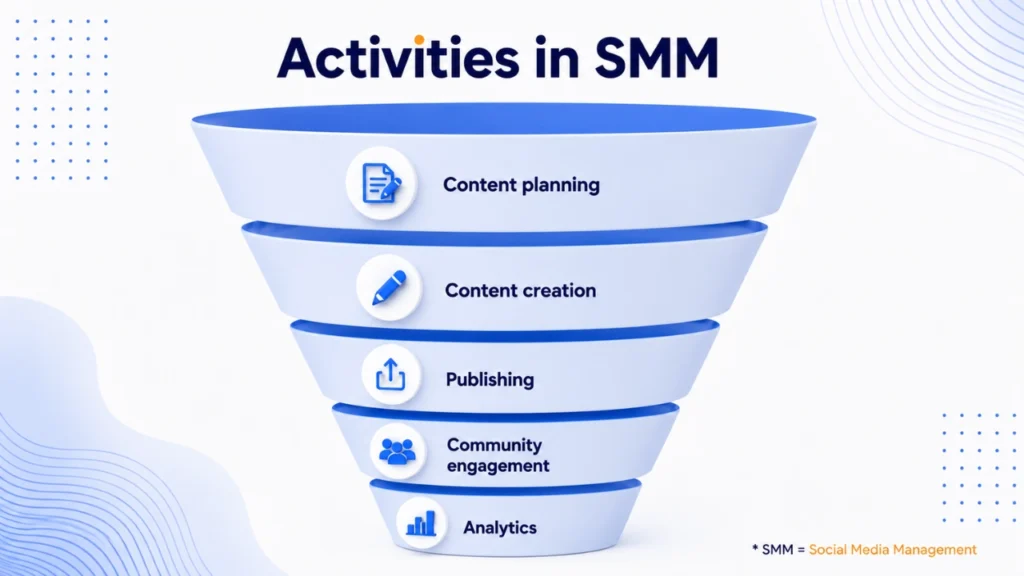
At its core, social media management covers five areas:
- Content planning: deciding what to create, when to post, and why
- Content creation: producing graphics, videos, and written content
- Publishing: scheduling and distributing content across platforms
- Community engagement: replying to comments, DMs, and mentions
- Analytics: tracking what is working and adjusting what isn’t
These five activities support each other. A strong content plan makes creation easier. Consistent publishing builds the audience that engagement then strengthens. Analytics closes the loop by showing you what is actually working and what needs to change.
Why Is Social Media Management Important for Small Businesses?
Social media gives small businesses low-cost, direct access to the people most likely to buy from them. Research from HubSpot’s Social Media Marketing Industry Report found that 83% of marketers reported increased brand exposure through social media, 73% drove more website traffic, and 65% generated new leads. Those results don’t come from random posting.
For small businesses specifically, the opportunity goes beyond visibility. Social media is one of the few channels where you can compete for audience attention alongside larger brands without requiring a large advertising budget.

How Does Social Media Help Build Customer Trust?
Trust is built through consistency, not reach. When your business shows up regularly, responds to questions, and shares content that reflects who you are, people form an impression long before they contact you.
A business that replies to comments within a few hours feels fundamentally different from one that goes quiet for weeks. That kind of responsiveness is something larger brands often can’t maintain at scale. For small businesses, it’s one of the clearest competitive advantages available, and it costs nothing except time.
How Can Social Media Support Business Growth?
Social media moves people through your marketing funnel at a fraction of the cost of paid advertising. Organic content builds awareness. Engagement builds interest. A well-placed call to action converts that interest into real business outcomes.
There is also an indirect benefit worth noting. An active social presence drives traffic to your website, increases how long visitors spend on your pages, and signals to search engines that your brand is current and credible. Over time, that compounds into better search visibility too.
Core Components of Social Media Management
Understanding how the process works helps you manage it better yourself. It also helps you ask sharper questions when evaluating whether someone else is doing it well.
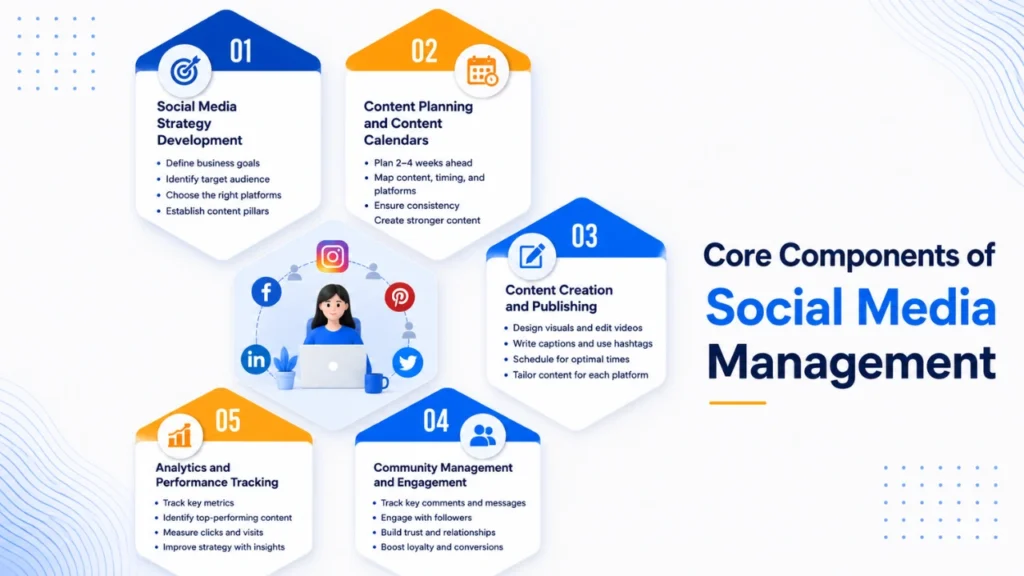
Social Media Strategy Development
Everything starts here. A strategy defines your business goals, identifies the specific audience you are targeting and determines which platforms make sense for both. Without this foundation, content decisions get made by guessing, and guessing produces inconsistency.
A good strategy also establishes content pillars: the recurring themes your content will build around, such as education, behind-the-scenes content, customer stories and direct promotion. These pillars give your content direction and make planning significantly easier month after month.
Content Planning and Content Calendars
A content calendar maps out what gets published, where and when. Most are planned two to four weeks in advance. The practical benefit is removing the daily scramble of figuring out what to post, which is one of the main reasons small business social accounts lose consistency.
Planned content is almost always stronger than reactive content. When you know what you’re making before the day you need it, there’s time to get it right.
Content Creation and Publishing
This is the visible layer. Designing graphics, editing short-form videos, writing captions, selecting hashtags and scheduling posts at the times that give each platform’s algorithm the best chance to distribute your content.
What many small businesses underestimate is that each platform has different content requirements. A post designed for Instagram rarely translates directly to LinkedIn. Video edited for TikTok may need restructuring for YouTube Shorts. Effective content creation accounts for the platform, not just the message.

Community Management and Engagement
This is the piece most small businesses skip, and the one that costs the most when neglected.
Replying to comments, answering messages, and engaging with your followers’ content signals to the platform’s algorithm that your account is active and worth distributing. More importantly, it signals to your audience that there is a real business behind the profile. People who feel acknowledged are significantly more likely to return and convert than people who don’t.
According to HubSpot’s 2025 research, 85% of social media marketers say building an active community is crucial to a successful social strategy. Community management is where that community actually gets built, one reply at a time.
Analytics and Performance Tracking
Metrics exist to inform decisions, not just to measure activity. The relevant questions are: which content formats drove the most reach? Which posts led to website clicks or profile visits? When did your audience engage most?
Reviewing these patterns regularly is what separates a strategy that improves over time from one that keeps repeating the same approach and producing the same flat results.
What Social Media Platforms Should Small Businesses Focus On?
You don’t need to be everywhere. Spreading across six platforms with limited capacity produces thinner results than focusing on two with consistent, well-crafted content.
The right starting point is where your audience already spends time, combined with what type of content you can realistically produce on a regular basis. Here is where different business types tend to find the most traction.

Instagram for Brand Awareness and Engagement
Instagram works best for businesses with a visual product or service: food, retail, fitness, beauty, interior design. With over 2 billion monthly active users and a strong short-form video format through Reels, it gives small businesses a real opportunity to build brand recognition without paid advertising.
Reels currently offer some of the highest organic reach available on the platform, making it one of the more practical options for early-stage visibility.
Facebook for Community Building and Local Reach
Despite the perception that Facebook is losing relevance, it remains the strongest platform for local businesses. Its Groups feature, event listings, and community pages give physical businesses and service providers genuine tools for building local relationships.
Facebook also has the widest age distribution of any major platform, which makes it the right choice for businesses whose customers are not exclusively in the 18 to 30 range.
LinkedIn for B2B Businesses
If your clients are businesses rather than individual consumers, LinkedIn is where the decision-makers are. It is the strongest platform for establishing professional credibility, sharing industry insight, and building relationships that lead to B2B conversations.
For B2B businesses, a well-maintained LinkedIn presence often does more for lead generation than any other social channel.

TikTok for Organic Growth Opportunities
TikTok still offers the kind of organic reach that most established platforms no longer provide. A small account with genuinely useful or entertaining short-form video can grow quickly without advertising spend. If your audience skews younger and video content fits your brand, the growth opportunity here is significant and largely untapped by most small businesses.
YouTube for Long-Term Content Visibility
YouTube content is indexed by Google, which means a video published today can still attract traffic two or three years from now. For businesses that can invest in educational, how-to, or demonstration content, it is the only social platform that compounds over time the way a well-written blog post does.
Social Media Management Services Explained
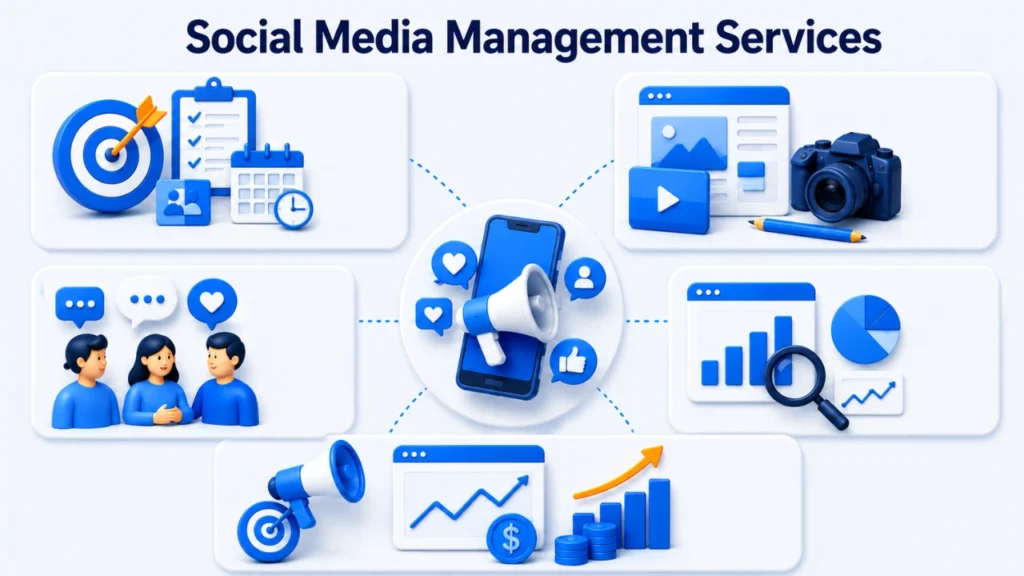
When you hire someone to handle your brand’s social presence, you are purchasing social media management services: a defined set of deliverables covering some or all of the activities described above. Knowing what each service involves helps you evaluate exactly what you are buying.
Strategy and Content Planning Services
This is the foundation layer. A provider audits your existing social presence, researches your target audience, defines your content pillars, and builds a content calendar. The output is a clear plan that guides every decision that follows.
Businesses that skip strategy and jump straight to content creation often find themselves producing a lot of posts with no clear direction, then wondering why results don’t follow.
Content Creation and Publishing Services
Graphics, short-form video, caption writing, hashtag research, and scheduled publishing. A good provider creates platform-specific content rather than repurposing the same asset across all channels.
At a minimum, ask to see examples of their work for brands in a similar industry. Content style and quality vary significantly between providers, and the difference is immediately visible.
Community Management Services
Daily monitoring of comments and messages, replying to followers, engaging with relevant content, and flagging issues that need your attention. This service is often included in higher-tier packages and offered as an add-on at starter level.
It is the most time-intensive service to deliver well, which is also why it is the one most commonly done poorly by providers managing too many accounts at once.
Analytics and Reporting Services
Monthly reporting covering reach, engagement, follower growth, content performance, and website traffic from social. A useful report doesn’t just present numbers. It explains what those numbers mean and identifies what to adjust going forward.
If a provider’s reporting is a screenshot from Instagram’s native insights with no interpretation, that is worth probing further before committing.
Paid Social Media Management Services
Running and optimising paid advertising campaigns on Meta, LinkedIn, or TikTok Ads. This sits alongside organic management as a separate scope, with its own budget for ad spend on top of any management fee.
Paid social is worth considering once your organic content strategy is established and you have a clear conversion goal. Running ads without that organic foundation in place tends to produce weak returns.
Types of Social Media Management Packages
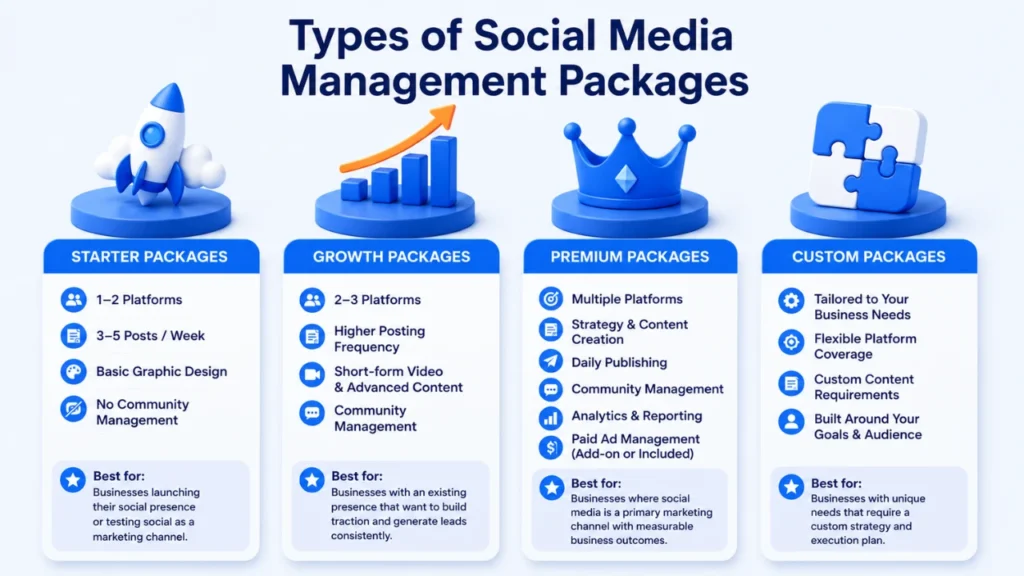
Social media management packages are typically structured in tiers, with each level defined by the number of platforms covered, weekly content volume, and the breadth of services included.
Starter Packages
Starter packages usually cover one to two platforms with a set number of posts per week, typically three to five, alongside basic graphic design. Community management is generally not included at this level.
Best for: businesses launching their social presence for the first time, or those testing social as a marketing channel before committing to higher investment.
Growth Packages
A step up in scope and output. Growth packages typically include two to three platforms, higher posting frequency, more sophisticated content creation including short-form video, and some level of community management.
Best for: businesses with an existing presence that want to build consistent traction and move toward using social media as a genuine lead generation channel.
Premium or Full-Service Packages
Full management across multiple platforms: strategy, content creation, daily publishing, community management, analytics reporting, and often paid ad management included or available as an add-on.
Best for: businesses where social media is a primary marketing channel and the investment is expected to produce measurable business outcomes.
Custom Packages for Unique Business Needs
Standard tiers don’t fit every business. A seasonal operation, a brand targeting both B2B and B2C audiences, or a business with multilingual content requirements will need something built around their specific situation rather than a template.
Most reputable providers will build a custom scope if you ask. If they won’t, that tells you something about how flexibly they actually work.
Social Media Management Pricing: What Should Small Businesses Expect?
Social media management pricing typically ranges from around $300 to over $5,000 per month. That range reflects real differences in scope, provider type, and what is actually included in the engagement.
Factors That Influence Pricing
The main cost drivers are: number of platforms managed, weekly content volume, whether video production is included, the level of community management, paid ad management, and the depth of reporting.
Each of these adds hours to deliver properly. More platforms, higher content volume, active engagement, and detailed reporting all require proportionally more time, which is reflected directly in pricing.
Monthly Retainer Pricing
Most agencies and freelancers work on a monthly retainer model. At the lower end of the range ($300 to $800), you are typically getting basic organic posting on one to two platforms with minimal strategy input. Mid-range retainers ($800 to $2,500) add video content, more frequent publishing, and meaningful community management. Upper-tier retainers above $2,500 usually include multi-platform management, paid social oversight, and a dedicated strategic partner rather than just an executor.
Project-Based Pricing
Some providers offer project-based pricing for a defined scope: a profile setup and optimisation, a campaign launch, or a batch of content created in advance. This model suits businesses that need help for a specific period or purpose rather than an ongoing engagement.
How to Evaluate Value Beyond Cost
Cost alone is a poor filter. A cheaper provider producing low-quality content, or one who disappears after onboarding with no strategic input, costs more in the long run than a slightly more expensive one who delivers consistent, measurable work.
Before comparing prices, compare scope. What is actually included each month? How is performance tracked and reported? Is strategy part of the engagement or purely execution? These questions reveal far more than the monthly number does.
Choosing the Right Social Media Management Partner
Freelancer vs Agency vs Company
A freelancer offers flexibility and lower cost, making them a practical fit for small businesses with straightforward needs and limited budgets. The risk is capacity: one person managing several clients can struggle with consistency, particularly for community management and fast turnarounds.
A social media management agency brings a team, structured processes, and broader platform expertise. Costs are higher, but so is accountability. A social media management company operating at the larger end of the market typically serves businesses with complex multi-channel needs and budgets to match.
For most small businesses, a boutique agency or an experienced freelancer with demonstrated results in a similar industry represents the best combination of quality, cost, and ongoing support.
Questions to Ask Before Hiring
These four questions will tell you more than any proposal document:
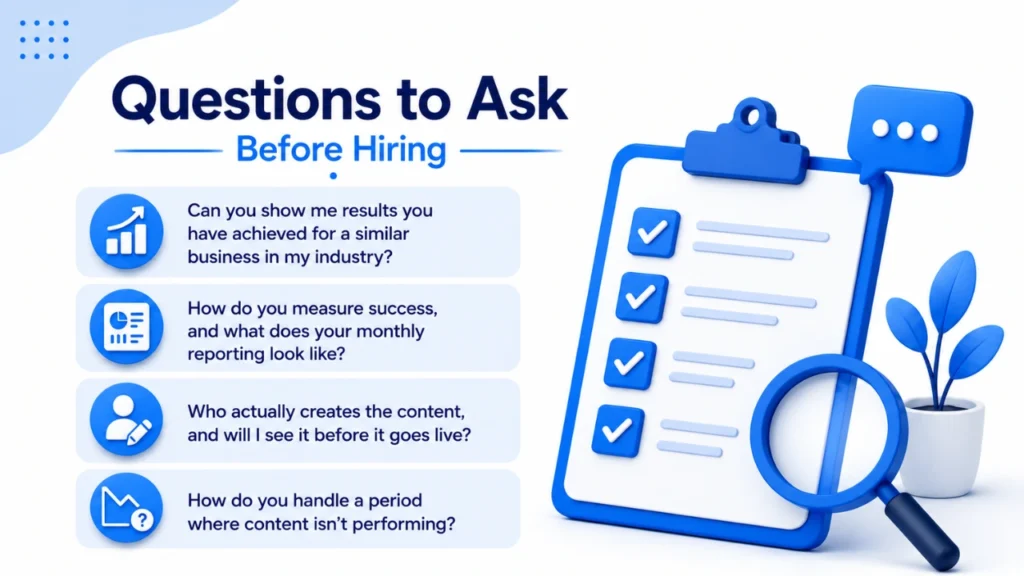
Vague answers to any of these are worth taking seriously before you sign anything.
Red Flags to Watch For
Watch for these warning signs before committing:
- Promises of guaranteed follower growth or viral results
- No performance metrics or KPIs discussed at the start of the engagement
- Generic content samples that could belong to any business in any industry
- Inability to explain their content strategy in plain, clear terms
- Long contracts with no performance review clause built in
How to Evaluate Experience and Results
Ask for case studies, not just follower counts. A provider who grew a client’s account from 200 to 10,000 followers with no supporting engagement or revenue data is less useful than one who drove 400 qualified website visits from a 3,000-follower account.
Platform-specific experience matters too. Managing Instagram effectively requires a different skill set than managing LinkedIn. Confirm that the provider has real, recent experience on the platforms your business actually needs, not just the ones they default to.
How to Build a Social Media Management Strategy for Your Business
If you’re managing social media yourself, this five-step framework is where to start. Most businesses skip at least two or three of these steps, and that’s usually where the inconsistency begins.
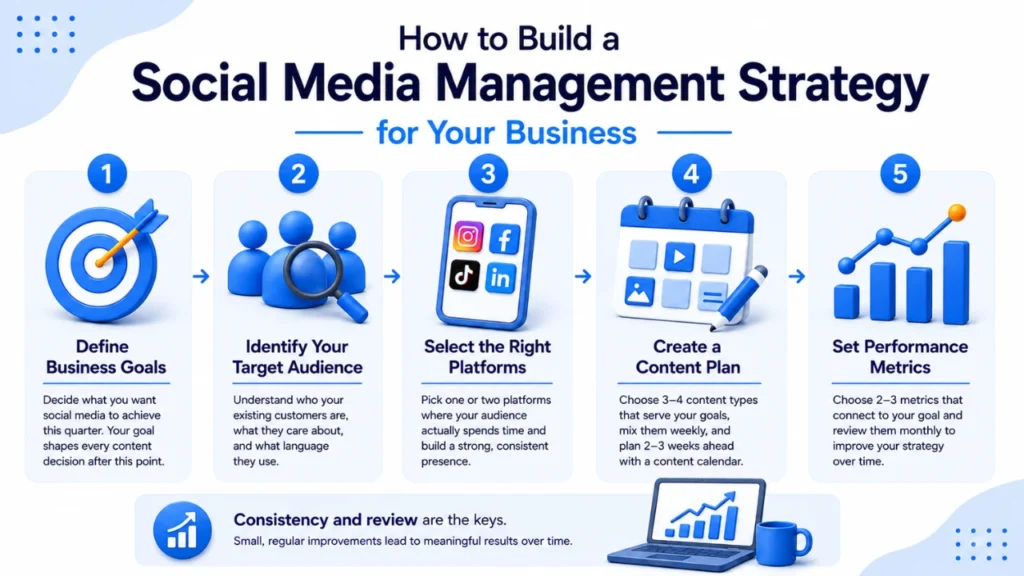
Define Business Goals
Before opening any platform, decide what you want social media to achieve this quarter:
- More foot traffic?
- More website enquiries?
- Greater brand awareness in a specific location or niche?
Your goal shapes every content decision after this point. Without this clarity, content ends up trying to do everything and achieving nothing in particular.
Identify Your Target Audience
Start with your existing customers. Who are they, what do they care about, and what language do they use when describing the problem your business solves? That information tells you directly what content will resonate versus what will get scrolled past.
Select the Right Platforms
Pick one or two platforms based on where your audience actually spends time, not where you feel you should be. Build a strong presence there before expanding. A focused approach consistently outperforms a spread-thin one.
Create a Content Plan
Rotate three to four recurring content types across your weekly schedule:
- Educational posts
- Behind-the-scenes content
- Customer stories
- Direct product or service content
Plan two to three weeks ahead using a simple content calendar. Even a basic spreadsheet works. The goal is knowing what you’re creating before the day you need it.
Set Performance Metrics
Choose two or three metrics that connect directly to your goal and review them monthly:
- Awareness goal: track reach and impressions
- Engagement goal: track comments, saves, and shares
- Traffic goal: track link clicks
Monthly reviews take ten to fifteen minutes. That habit alone is enough to build a strategy that genuinely improves over time.
Measuring the Success of Your Social Media Strategy
Most small businesses track followers and likes. These are among the least useful metrics for understanding whether your strategy is producing real results.

Awareness Metrics
Two numbers tell you how widely your content is spreading:
- Reach: unique accounts who saw your content
- Impressions: total views including repeat views
Reach growing month over month means your content is finding new audiences. Flat reach despite consistent posting means the content format or frequency needs adjusting.
Engagement Metrics
Comments, shares, and saves show how people actually respond to what you post. Saves on Instagram are a particularly strong signal because they mean someone found your content worth returning to. A high save rate with modest likes often reflects stronger, more purposeful content than a post that collected passive scroll-bys.
Traffic and Lead Generation Metrics
Link clicks and website sessions show whether people are moving beyond the platform to take action. If your content drives profile visits but no website clicks, the problem is usually your bio or call to action, not the content itself.
Conversion and Revenue Metrics
The deepest layer is whether social activity leads to actual business outcomes:
- Form submissions
- Booked appointments
- Direct purchases
- Inbound enquiries
Tracking this requires connecting your social analytics to your website data, but it is the clearest way to show the actual business value of your social media investment.
Common Social Media Management Mistakes Small Businesses Make
Posting Without a Strategy
- Content without a goal produces activity, rarely results
- Your audience responds to intention, and its absence is more visible than most expect
Ignoring Audience Engagement
- Posting and going quiet signals a broadcast channel, not a business that values its customers
- Platforms weight engagement heavily in distribution decisions. So do people.
Focusing Only on Followers
- A large following that doesn’t engage is expensive decoration
- Ten thousand inactive followers are worth less than one thousand who comment, share, and click
Inconsistent Content Publishing
- Platforms deprioritise accounts that go quiet
- Your next post after a long gap reaches far fewer people than one from a steady, consistent account
- Consistency doesn’t mean daily. It means predictable.
Not Tracking Performance
- Publishing without reviewing means making the same decisions with no learning built in
- A monthly review identifying which posts performed best and why is enough to meaningfully improve over time
Final verdict
Effective social media management for small businesses comes down to being intentional where it counts rather than present everywhere without purpose. A clear strategy, the right platforms, content that serves your audience, and consistent execution will outperform volume every time.
If you are exploring professional social media management services, comparing packages, or working through what pricing actually reflects, use this page as your reference. And if you are building your approach in-house, the strategy framework above is the right place to start.
The best time to build your social media presence properly is before the inconsistency becomes a pattern that takes twice as long to fix.
The full-stack creative agency — social media, video, web design, and automation for growing businesses. Based in Chennai, serving India + international clients.
Related posts
How to Create Instagram Reels for Business Without Showing Your Face
Social MediaHow to Grow Your Instagram as a Local Business in India (2026 Guide)
Business GrowthGoogle Business Profile Not Showing Up? 7 Real Reasons and How to Fix Each One
Want us to build systems like this for your business?
Content, websites, and automation — handled for you.
Book a call